Stefyvet · Algarve · brand, site and a platform feature
She does not have an address. She has a week.
Stefania is a vet who goes to the animal instead of making the animal come to her. Home visits, across the western Algarve, arriving with the equipment rather than expecting a frightened cat to survive a car journey to a room that smells of other animals.
That fixes the medicine and breaks the website. Every template for a small practice assumes a place: an address, a map, opening hours, directions. She has none of those. What she has is five areas and the days she is in each of them, and no template knows what to do with that.
Zones5
Basemap © OpenStreetMap contributors. Captured once and stored with the page, so nothing is requested from anybody while you read this.
Why this one and not another
ParrotB needed a first customer who would break it.
ParrotB is a platform for businesses that cannot answer the phone while they work: a front desk, a diary, forms, e-sign, a site. It was ready to be argued about and not ready to be believed, because nothing had run it in anger.
Stefania was alpha customer number one. A vet working in home visits across the western Algarve, which made her the most useful possible first tenant: a real business, with real customers, whose way of working the template could not describe. She has no address, no waiting room and no opening hours. She has areas and the days she is in them.
Everything on this page came out of that. The brand, the site and one piece of the platform were built for her, and then the platform kept all of it.
Her own line for what she does is the best sentence written on the project: the vet who comes into the house. Careful medicine with the manner of a visit between friends. Three words came out of it and every decision after was checked against them: domestic, attentive, expert.
There was no brand. There is one now
Built to be applied correctly by somebody who is not me.
The test was never “does it look good”. It was whether this could be applied properly in a year, by anyone, without me in the room. That question changes what you make.
That last one is the difference between a brand book and a brand that survives. A book is a document somebody has to remember. Tokens are a thing the build simply does.
Twelve pages, and one rule that outranked all of them
One rule decided the shape of everything after it.
It came out of the architecture document and it is the reason the site is built the way it is.
She must be able to change every visible piece of content herself, from the dashboard, without a developer.
architecture.md, the line that governed the buildEasy to write, and the thing most small business sites quietly fail. It means no copy baked into a template, no price living in a file, no opening line that needs a deployment to change.
So the deliverable is not twelve pages. It is sixteen section types, locked at version 1.0, which is the contract saying exactly which fields she owns and which ones she cannot break by accident. The pages are what those sections happened to build first: home, services, a service detail, how it works, about, a page for clinics, blog and article, contacts, privacy, welcome, and a 404.
What the first customer changed about the product
She said no to the thing the platform is named for.
ParrotB answers the phone. It is the flagship, it is the headline on every page of the product site, and it is what the whole thing was named for.
She was not interested in the voice agent. She was happy with everything else: the diary, the forms, the e-sign, the site. So the receptionist stayed on the shelf and the rest went to work, which is a finding rather than a disappointment. The voice was the part that had to be sold. Everything around it was simply taken.
The change that came out of her feedback is on the platform for everybody now: a job no longer has to arrive through the voice agent. It can arrive through a form, and the form is not tied to one place. Send it as a link in a message, or put it inside a website, and the request lands in ParrotB either way, in the same shape as a call. The intake stopped being one door.
Two projects started there. The first is ParrotB sites: the beginning of the site becoming something a business can buy on its own rather than an add-on to a phone product. It is a direction the product is going in, not a finished repositioning. The second is the form builder, and it is the one that did more work than anyone expected.
One form, doing three jobs at once for her:
- The anamnesis. What is wrong, since when, what changed, what the animal has had before. The questions she would have asked on the phone, asked once and written down, so the visit starts from something rather than from nothing.
- A register of the animals, built as the requests arrive rather than typed up afterwards, and built to hold what a health record has to hold. GDPR shaped it: the owner is a person with rights over their data and the animal's record is attached to them, so consent, retention and export were decided before the first row existed rather than retrofitted around it.
- The service area, answered before anything else, because if she does not come to them the other two questions are a waste of their evening.
A platform that only fits customers who want all of it is not a platform. It is a bundle.
the thing alpha one was forWhat the five shapes at the top of this page are for
The question is not whether she comes. It is which day she is already coming.
A vet who drives does not drive everywhere every day. Each zone she draws is active only on the days she picks, so the map is not a boundary, it is a timetable. Her customer never sees it and gets the answer that falls out of it.
Today that answer arrives after they send the request. The location they type is read against the zones, the request is assigned to a day, and somebody outside every zone is told so rather than left waiting. It works, and it is one step later than it should be.
Below is the version that moves it forward, into the field itself, and it is designed rather than shipped. It is on this page because the decision is the interesting part and because the site does not print things it has not thought through, but nobody has used it yet.
Why that had to be hers to change
A service area is a business rule, and it is the one most likely to change. She takes on a new town, drops a route in winter, moves house. Every one of those is a redraw rather than a ticket, an estimate and a wait.
It is also why this was worth building into the platform rather than for her. A plumber who covers three postcodes, a piano tuner who will not cross the river, a mobile groomer with a van: every one has an area, every one changes it, and none of them should have to ask anybody.
What she actually got, and why it is three things rather than one
She bought all three. Most businesses will buy one.
Stefyvet is the only project so far where all three builds were delivered at once, which makes it the clearest description of what each one is. There is no order to them and nothing to climb: a business that already likes its brand buys Site, one that only wants to look like itself buys Brand and stops, and the largest projects start at Software and never touch the other two.
The three builds are design work, quoted per project. The subscription underneath them is ParrotB's own, at ParrotB's own price, and it does not change because a designer was involved.
two different things, on two different bills, on purposeThat separation is the whole commercial idea. The platform is already running, with paying customers, an uptime record and a roadmap. Nothing here rebuilds a phone system, a diary or a hosting stack, which is why a custom build costs what it costs instead of what a bespoke agency build costs. What is bought is the surface, the words and, in a Software build, a capability the platform did not have yet.
Stefania runs on the base platform, the website module and the back office. No reception module, because she did not want one, which is the shape of the subscription rather than a discount on it.
Look like yourself.
There was nothing before this. The mark is a veterinary cross with a cat and a dog folded into it as one continuous line, which is the positioning in a shape: two species, one household, medicine that arrives calmly. Built to be applied without me, which is why it ships as data as well as artwork.

On the billA project fee, once. Nothing on the subscription changes: a brand is not a module, and a business can take this and put it on whatever it already runs.
Built the way she sells.
Twelve pages, and the deliverable is not the pages. It is sixteen section types, locked at version 1.0: the contract saying which fields she owns, so she can change her prices, her services and her opening sentence without asking anybody. It also had to carry two businesses at once, hers and the locum surgery clinics hire her for, without either diluting the other.
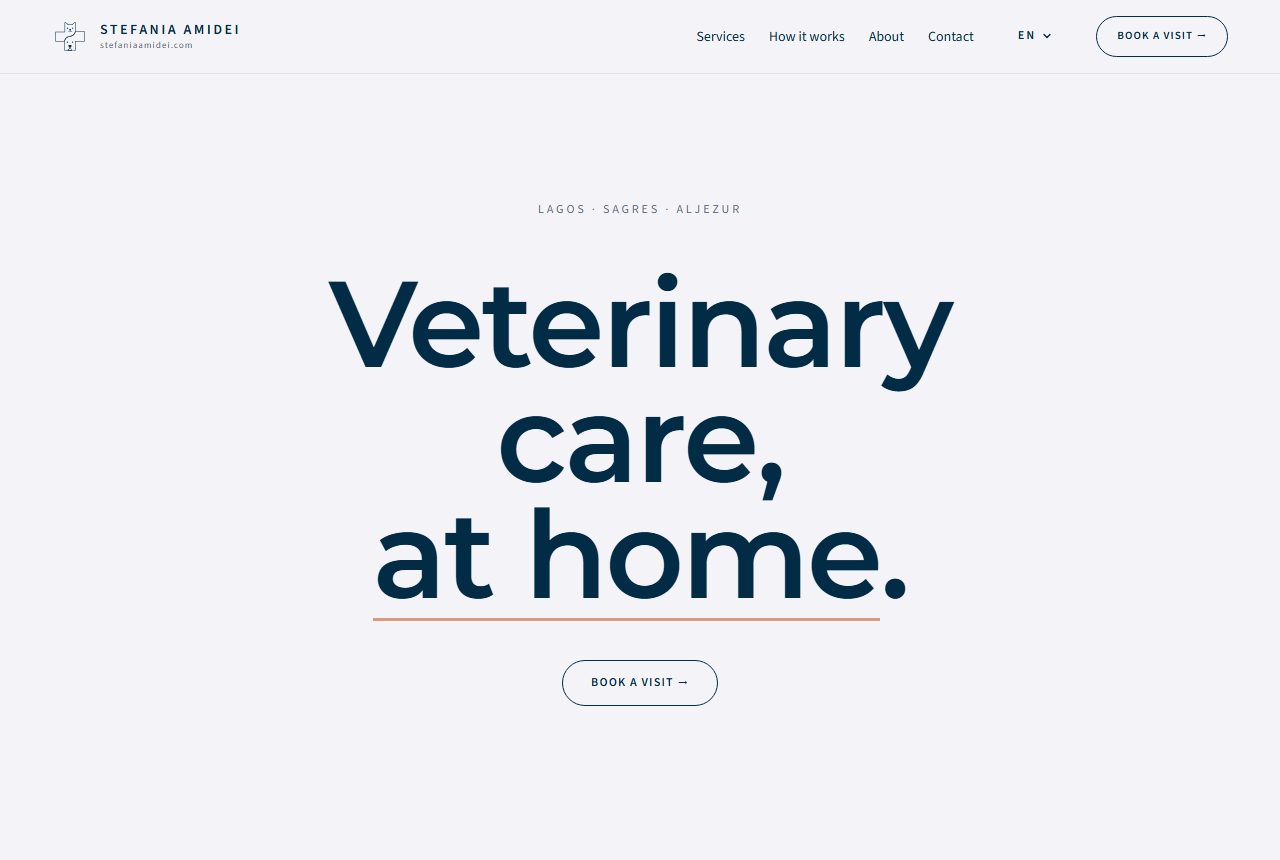
/pt and English at /en, both edited from the same dashboard rather than maintained as two sitesOn the billA project fee, once, and then the website module on the ParrotB subscription at its published price, because that is what hosts it, serves it and lets her edit it. The design is bought. The running is rented, and it is rented from the product rather than from me.
Something the platform could not do.
Her business only works inside the areas she drives to, and no template knows what to do with that. So it became product rather than a special case: zones as shapes on a map, each active only on the days she chooses, checked before a booking form is ever drawn. Specified as ten epics and around fifty prioritised requirements, with the database fields, the API contracts and the migrations, and handed to the platform side rather than bolted onto her site.
What her customer fills in · example
What arrives in ParrotB
On the billA project fee for the design and the specification, and the capability then belongs to the platform. She pays build cost once rather than bespoke cost, and every tenant who comes after her gets service areas as a field they fill in. That is the trade, and it is stated in the contract rather than discovered in it: the customer funds a capability instead of buying a system, which is why the number is what it is.
The turn, and the only part that matters in a year
Solve it for her, or solve it once.
A client with an unusual constraint is an invitation to build them something bespoke. It is faster, it is easier to sell, and it produces one happy customer and nothing else: the second business with the same problem starts from zero, and so does the third.
So the work was split down a different line. Everything specific to her became configuration; everything general became the platform. Her zones are shapes in a table. Her sections are types. Her brand is tokens. Her domain is a tenant record.
She is tenant one, so the measure of the work is not her site at all. It is whether the second client can be onboarded without a developer.
if yes, the design was right. If no, a bespoke site was built with extra stepsOne customer's problem became the product's shape. The week she happens to drive is now a capability the platform has, and the next business that only covers three towns gets it as a shape they draw.
Where it stands
One tenant, on two domains, answering requests.
Every tenant gets a domain on day one, without buying anything: name.parrotb.com is issued with the account and it is a real address, not a preview link. If they want their own, they buy it and it points at the same site, and the subdomain keeps working underneath. Nothing is rebuilt, nothing moves, and the day they decide is not a migration.
Stefania decided. Live at stefyvet.com, her own domain, which she bought. stefyvet.parrotb.com resolves to the same site, and that is the part worth pausing on: the platform serves one tenant on its own subdomain and on a domain the customer owns, with the customer's canonical. The multi-tenant model is not a diagram in a document, it is answering requests.
A custom build, and you can take one third of it
Look like yourself. Sell the way you work. Or make the software do what you do.
Everything on this page is available to any business on ParrotB, and it is called a custom build. Three of them, bought separately or together in any order, priced per project, and delivered on a platform that is already running rather than on something built from nothing for you. That is why it costs what it costs.
Brand
Look like yourself
You stop looking like a template.
- A mark, a palette, type and the rules for using them
- Applied to your site, so it is live rather than a folder of files
- Print: card, and whatever else you hand people
- The whole thing as data, so anyone can apply it later without me
You look like one business everywhere, including on paper.
Site
Sell the way you work
A site built the way you sell, not the way a template assumed.
- Pages that follow your argument instead of a stock structure
- An enquiry flow that asks what you would have asked on the phone
- Written in your voice, in as many languages as you need
- Measured at three widths, and for accessibility, and reported as results
You change every word of it yourself, without calling anybody.
Software
Software that fits
The platform learns to do what your business does.
- Starts with a short paid piece of work that scopes it, and either of us can stop there
- Research, the flows, then a prototype tested with real people before anything is built
- Built into ParrotB, not bolted onto your site
- Phased go-live and training
The thing that does not fit becomes a capability, and you pay for it once.
The subscription is ParrotB's, at ParrotB's price. The domain is yours, registered in your name, with the platform running the DNS, and you can take both anywhere. Anything built for you that turns out to be a capability rather than your identity becomes part of the platform, which is why you pay build cost once instead of the cost of building it from nothing. Your brand and your identity stay exclusively yours in every case.
Who this is not for. If what you need is a good site and nothing unusual, ParrotB's own website module does that for a monthly fee and you do not need me for it. This is for a business whose brand is what it competes on, or whose way of working a template cannot describe. If that is not you, the cheaper answer is the right one and I will say so.
And this is how it runs, so nothing about it is a surprise
- A call. Not a form and not a trial. Fifteen minutes is usually enough to know whether this is the right thing for you, including when it is not.
- A scope, then a fixed quote. In that order, because a number given before the scope is a number somebody has to eat later.
- A daily email. Three lines every working day: what was done, what is next, what is waiting on you. Nobody ever wonders what is happening.
- Approvals on a form, dated. Unlimited changes while a stage is open, none after it closes. Two or three directions first, then one design taken properly, so a wrong turn costs half a day rather than a fortnight.